Hearth as a Structural Language: Intersection of Community and Fire Station
PARTNERS:
CHRISTIAN DUCKWORTH
LISA CHUN
INSTRUCTOR:
ANDREW STONE
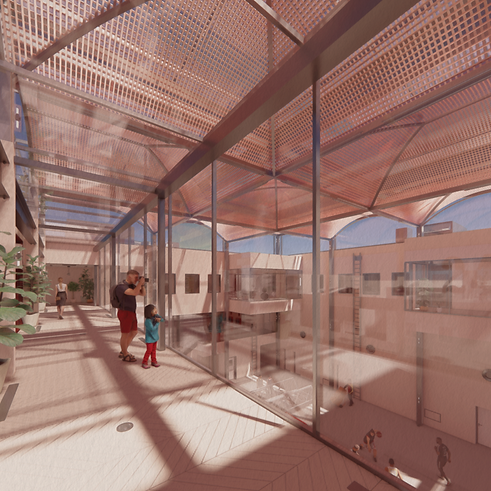
The structural narrative of our fire station is centered around the “hearth” of our design, which refers to the spaces that function as the symbolic core of our building. A “hearth” in a domestic concept is the most integral part of one’s home and functions as the centralized gathering space; in the fire station, it refers to the programmatic spaces where the community and firefighters intersect. From East Carson St, the apron invites the community into the active “hearth” of the apparatus bay: the primary vehicle of intersection and a key component of the fire station. It borders public facing programs that radiate in plan and section around the site, such as the lobby, meeting room, public restrooms, receiving space, library, public gardens, and an elevated walkway that allows the public to view into the apparatus bay without disturbing the work of the firefighters.
The structural system seeks to empathize this concept through the revealing and concealing of a steel frame. Locally manufactured to reduce embodied carbon loads, this steel structure is concealed in the more private and intimate spaces in the fire station. Inspired by the Victorian style of architecture around the site, the steel frame takes the formal shape of groin vaults in the apparatus bay. Its expressive geometry seeks to transform the utilitarian function of the bay into a monumental space, paying structural homage to the neighborhood’s vernacular. Historically these types of spatial gestures were used in the interior of churches, which were the primary spaces of gathering and community in the Southside Flats neighborhood that was once home to a primarily working-class immigrant population. Today this community dynamic is much different, as the area is primarily white collar and single resident community spaces are restricted to the bars and nightlife scene, which excludes younger residents and puts up a paywall for others preventing them from being able to engage with their fellow community members.
The revealing of the structure in the hearth space then becomes an interplay of referencing the formal language of the neighborhood as well as an experience of light as a means of signifying a space of gathering and connection. This grand gesture uses structure as a tool to signify atmospheric transition: while in the main feature in the “hearth” steel is revealed, the hidden structures in the more intimate spaces will offer contrast to the celebration of structure. The vaulted steel frame system will use tension cables to allow for a wide span, using less steel than a traditional steel structure. The natural light flowing through the complex structure will direct attention toward the hearth and its grandiose form.
Directly contrasted to the open space of the apparatus bay are intersecting supporting spaces connected to more intimate programs; views into the apparatus bay provide an experiential difference between the public “hearth” and the private residential and business zones to separate work and life in one building. Allowing the structure to step back in these spaces will further emphasize the importance of the apparatus bay for serving as the link between the fire station and the surrounding community as well as, shaping a more intimate and comfortable experience in the auxiliary spaces where softer, domestic finishes like wood and lower ceiling heights can be used to ground the space.
The structure is instrumental in creating a fire station that can function as both a strong civic anchor for the community and a comfortable private dwelling for the firefighters who spend much of their lives living in the station. “Hearth” is both a symbolic and spatial center of the fire station; its structural expression will bridge the gap between the fire station as a civic center and a home, while denoting it as a friend to the surrounding urban environment. The use of a contrasting structural language engages the community and enhances its function as a hearth for while giving firefighters the privacy and thus efficiency that is necessary for their crucial roles in the community.


